Artisan Ink
August 28, 2026
A Sak Yant tattoo is one of the most recognisable forms of Thai tattooing, but its visual familiarity often hides what the tradition actually involves. The geometry, the script, the symmetry, these are the parts people photograph. The practice behind them is older, more layered, and more personal than the images suggest.
If you are considering a Sak Yant in Chiang Mai or elsewhere in Thailand, or if you are simply drawn to Thai sacred geometry and want a tattoo inspired by it, it is worth understanding what you are looking at before the needle touches your skin. The same design can mean very different things depending on who applies it, how it is applied, and the intention behind it.
This guide explains the tradition honestly, separates it from the tattoo style it has inspired, and helps you ask the right questions before committing to something permanent. It is written for people who want to understand, not for people looking for a souvenir.
What Is a Sak Yant Tattoo?
The term itself tells you most of what you need to know. "Sak" broadly refers to tattooing or marking the skin. "Yant" derives from yantra, a word used across South and Southeast Asian spiritual traditions for a sacred geometric diagram or configuration. Put simply, a Sak Yant is a tattoo of a yantra.
What makes a traditional Sak Yant different from an ordinary tattoo is not only the image. Traditionally, the practice brings together several elements: the yantra or visual structure, sacred inscriptions or mantras, the intention associated with the design, the lineage and knowledge of the practitioner, and a blessing or ritual performed according to that lineage. The visible tattoo is one part of a larger practice.
This is why choosing a Sak Yant is not the same as choosing a Thai-looking design from a catalogue. A geometric pattern copied onto skin by a conventional tattoo artist may be beautiful and may draw on Thai visual culture, but without the other elements it is not automatically a traditional Sak Yant in the full sense. Understanding that distinction early saves a lot of confusion later.
Where Does the Sak Yant Tradition Come From?
Sak Yant does not have a single confidently identifiable starting date. The tradition developed over centuries from overlapping spiritual and cultural currents across mainland Southeast Asia, and trying to pin it to one origin or one moment tends to oversimplify a genuinely complex history.
The influences behind it are layered. Yantra traditions and sacred geometry travelled and developed across South and Southeast Asia over centuries. Buddhist teachings, Pali formulae, Indic religious imagery, regional writing traditions and longstanding local protective and spiritual practices became intertwined in different ways. Rather than belonging neatly to one religion or belief system, Sak Yant developed within the blended religious landscape characteristic of much of Southeast Asia.
Thailand is strongly associated with Sak Yant today, and for good reason, but related practices exist across parts of mainland Southeast Asia. The tradition is regional rather than purely national, even though Thailand has become the place most travellers encounter it.
The Design Is Only Part of the Sak Yant
This is the part that most people miss, and it matters more than any individual design.
A traditional Sak Yant is understood as an interconnected set of elements rather than a standalone image:
- The yantra, the visual structure, often geometric, sometimes incorporating figurative imagery such as animals or deities.
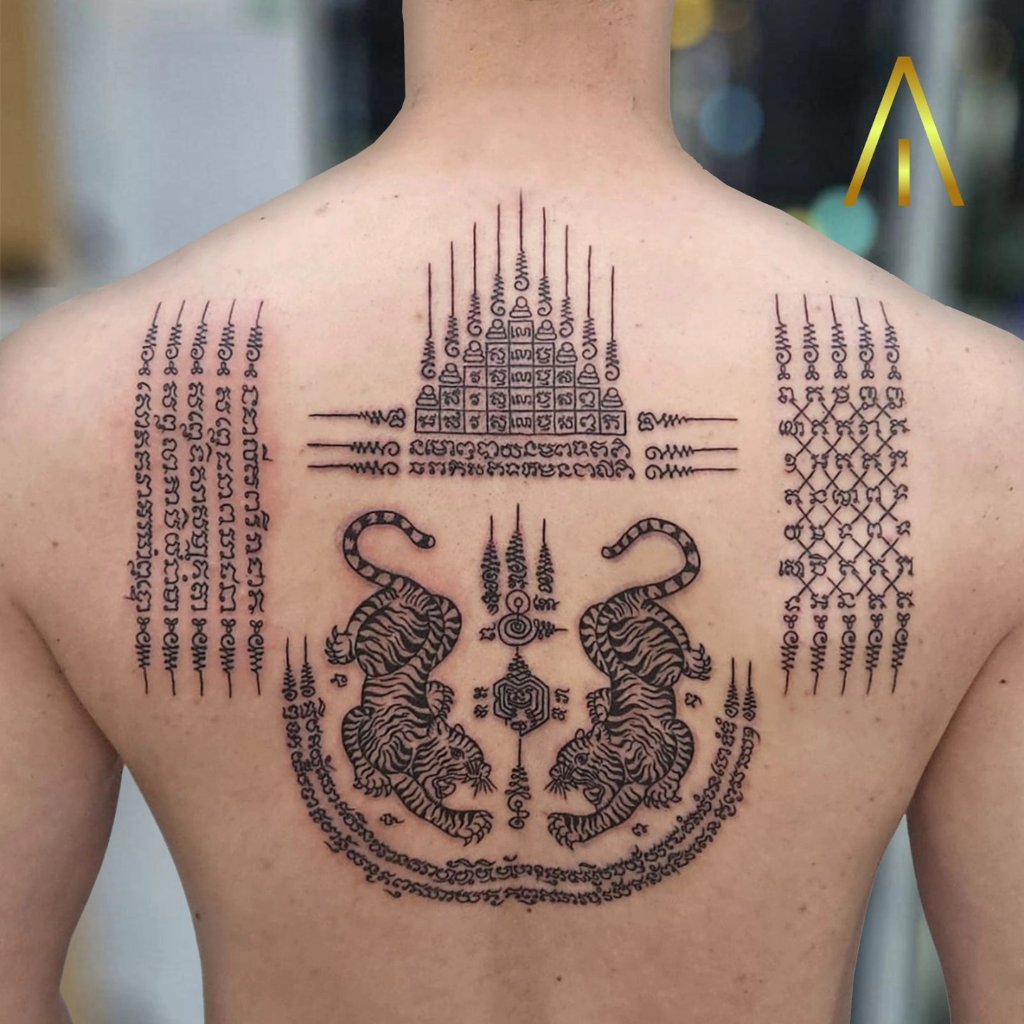
- The inscription or mantra, sacred formulae or mantras, often in Pali and written using traditional scripts such as Khom or related regional scripts, embedded within or around the design.
- The intention, the purpose associated with the yant, such as protection, fortune, courage or guidance.
- The practitioner and lineage, the knowledge and authority of the person giving the tattoo, passed through a line of teachers.
- The blessing or ritual, the chanting, prayer or ceremony through which the yant is traditionally activated or consecrated.
Copying the visible pattern alone does not reproduce the entire traditional practice. The geometry can be drawn by anyone with a steady hand, but the other elements belong to the lineage and the practitioner. This is not a judgement about quality, it is simply an honest description of what the tradition involves. A design can be visually faithful and still not carry the traditional practice behind it.
Monk, Ajarn and Tattoo Artist: What Is the Difference?
These three roles are often used interchangeably in travel writing, and the confusion leads to a lot of misplaced expectations.
A monk may practise Sak Yant within a temple or religious context, working as part of his spiritual role rather than as a commercial tattooist. The practice sits within his religious life and the expectations of his temple and order.
An Ajarn is a teacher or master. In the Sak Yant context, an Ajarn is often a lay practitioner, sometimes with previous monastic training, although backgrounds differ considerably between individuals. Some Ajarns maintain a dedicated practice outside the temple system, while others operate in settings that blend spiritual and folk traditions. There is no single template.
A conventional tattoo artist primarily works within tattoo artistry, design and technique. A skilled tattoo artist may produce excellent work inspired by Sak Yant imagery, but that work does not automatically carry Sak Yant spiritual lineage unless the artist also holds that lineage and performs the associated practice.
These are different roles rather than a ranking. A monk is not a better version of a tattoo artist, and a tattoo artist is not a lesser version of an Ajarn. They do different things, and understanding which one you are visiting tells you what kind of experience you are actually having.
Is Sak Yant the Same as a Bamboo Tattoo?
No, not necessarily, and the conflation causes more confusion than almost anything else.
The phrase "bamboo tattoo" has become a popular term in Thai tourism and tattoo marketing for hand-poked tattooing. It is used loosely, often as a selling point, and it has stuck. But it should not be treated as an automatic alternative name for traditional Sak Yant.
Traditional Sak Yant is commonly hand-poked, but the implement is usually a long metal rod rather than literal bamboo. The technique is hand-poked, the tool is metal, and the term "bamboo tattoo" has become common tourism and tattoo-industry shorthand for hand-poked tattooing.
More importantly, technique alone does not define a Sak Yant. A hand-poked tattoo is not automatically a traditional Sak Yant, and a traditional Sak Yant is not defined only by being hand-poked. The spiritual and cultural context is what separates the two, not the motion of the needle.
Popular Sak Yant Designs and Their Traditional Meanings
Certain designs appear again and again in Sak Yant practice, and they are the ones most people recognise. The meanings below are traditional associations, not fixed definitions. Interpretation, mantras and purpose can vary according to lineage and practitioner, so treat these as commonly understood references rather than universal rules.
Hah Taew
Hah Taew is the five-line yant, one of the most recognised Sak Yant designs. The five lines traditionally carry multiple blessings, commonly including forms of protection, fortune, charisma and success. The exact wording, the specific blessings associated with each line and the order in which they are understood can vary between masters and lineages, so the popular idea that the five lines always mean one fixed set of things is not accurate.
Gao Yord
Gao Yord is the nine-peak yant and is often described as one of the best-known master yants. The nine peaked spires are traditionally associated with protection and spiritual authority, and in some lineages it is treated as a foundational or first Sak Yant. As with every design here, the specific intention attached to it can differ between practitioners.
Paed Tidt
Paed Tidt is the eight-direction yant, a composition referencing the eight directions. It is traditionally associated with protection while travelling and protection from harm coming from different directions. Its association with protection in all directions has also made it particularly significant for travellers.
Suea, the Twin Tigers
The tiger, and particularly the twin tigers, is traditionally associated with courage, authority, strength and power. It is one of the more figurative Sak Yant designs and is often chosen by people drawn to what the tiger represents within the tradition. The meaning sits within the broader framework of the yant rather than as a standalone personality symbol.
Hanuman
Hanuman originates in Hindu tradition, where he is a central devotional figure, and his presence in Sak Yant reflects the layered cultural roots described earlier. In tattoo traditions he can represent qualities such as courage, strength, devotion and perseverance. As with the other designs, the way he is understood depends on the practitioner and the intention behind the specific yant.
The important point across all of these is that none of them carry one universal, fixed meaning. If you receive a traditional Sak Yant, the meaning you are given is the meaning according to your practitioner and their lineage, not the version you read online.
Does the Monk or Ajarn Choose Your Sak Yant?
This is one of the most repeated stories in travel writing, and it is more complicated than the popular version suggests.
Practices differ. In some settings, a practitioner recommends a yant based on the person's intentions, circumstances or what the practitioner feels is appropriate. In others, the recipient discusses preferences and intentions openly and the design is agreed together. There is no single rule that the recipient must always accept a completely unknown design in silence.
The popular tourist narrative, that you arrive, sit down and receive whatever you are given without question, does describe some lineages and some settings, but presenting it as a universal rule misrepresents the tradition. The honest answer is that it depends on where you go and who you see, and the right approach is to ask beforehand rather than assume.
What Does the Blessing Mean?
Within the tradition, a blessing or ritual may be used to consecrate or activate the yant. This can involve chanting, prayer and specific ritual actions performed by the practitioner according to their lineage.
It is not our place to present supernatural protection as proven fact, and we would not. These are traditional beliefs that are taken seriously by practitioners and recipients who operate within that spiritual framework.
For believers, the ritual is a fundamental part of what distinguishes Sak Yant from decorative tattooing. Within many traditional lineages, a copied design without that blessing or consecration may reproduce the imagery, but it does not necessarily represent the full traditional practice.
Are There Rules After Receiving a Sak Yant?
Behavioural expectations after receiving a Sak Yant vary between teachers and lineages. Some emphasise general Buddhist moral principles and personal conduct. Others maintain more specific rules connected to their particular tradition.
The internet is full of sensational lists presented as though all Sak Yant recipients follow the same fixed code. That is not accurate. Different practitioners teach different things, and the expectations attached to a yant depend on who gave it and within what lineage.
The correct advice is simple: understand and respect the expectations of the specific practitioner who gives you the tattoo. If they explain rules, take them seriously. If you are not clear, ask before the tattoo rather than after.
Can Foreigners Get a Sak Yant?
Yes. Many Sak Yant practitioners in Thailand receive foreign visitors as well as Thai recipients.
Accessibility does not remove the responsibility to understand what the tattoo represents. If you are considering a Sak Yant as a visitor, the same respect applies as to any culturally significant practice:
- Behave respectfully in the setting where the tattoo is given.
- Dress appropriately where religious settings require it.
- Listen to the practitioner and follow their guidance.
- Make a genuine effort to understand the design and its meaning.
- Approach sacred imagery as something with meaning within the culture rather than simply as an exotic design.
- Ask questions when you are uncertain rather than guessing.
The principle is straightforward: bring the same curiosity and respect you would to any tradition that matters deeply to the people who practise it.
This is particularly relevant in places such as Chiang Mai, where traditional practitioners, tattoo studios and visitor-facing Sak Yant experiences can exist within the same city while offering very different things.
Placement and Cultural Considerations
Placement can carry cultural or spiritual significance in Sak Yant tradition. Some sacred imagery, particularly Buddhist-related imagery, may traditionally be treated differently according to where it is placed on the body, and certain placements carry meaning that a casual choice would miss.
There is no single universal placement law that applies to every yant and every lineage. Rather than relying on Pinterest or social media for guidance on where a sacred design should sit, the reliable approach is to ask a knowledgeable practitioner. They can explain what is appropriate for the specific yant, for your intention and within their tradition.
Traditional Sak Yant vs Sak Yant-Inspired Tattoos
This is one of the most useful distinctions to understand, and it is worth stating plainly.
There are legitimate reasons to be drawn to Thai sacred geometry, traditional linework, symbolic composition and historical Thai visual culture. These are genuinely beautiful traditions, and a tattoo inspired by them can be a serious, considered piece of work. There is nothing inferior about wanting one.
But if a tattoo is created purely as artwork by a conventional tattoo artist, without the traditional ritual, lineage or blessing, it is more honest to describe it as Sak Yant-inspired rather than as a traditional Sak Yant. Calling it a traditional Sak Yant when it is not is where the problem lies, not in the tattoo itself.
This distinction is about honesty and respect, not about ranking. A Sak Yant-inspired tattoo is not a lesser tattoo. It is a different thing. A beautifully executed Thai geometry-inspired piece by a skilled tattoo artist is exactly that, and it stands on its own merits. The issue only arises when the language used to describe it implies a spiritual lineage or blessing that was not part of the process.
If what you want is the traditional spiritual experience, seek out a practitioner within that lineage. If what you want is artwork inspired by Thai tattoo aesthetics, a professional tattoo studio can offer different creative possibilities. Both are valid, and knowing which one you want is the point.
Machine Tattoo or Traditional Hand-Poked Sak Yant?
A tattoo machine and a traditional hand-poked technique place ink into the skin differently, and the experience differs accordingly. We would not make unsupported claims that one heals dramatically faster, hurts less or is inherently safer, because that is not how it works in practice.
Technique, practitioner skill, hygiene, individual skin and aftercare all affect the experience and the healing. A well-executed hand-poked tattoo by a careful practitioner and a well-executed machine tattoo by a careful artist can both heal cleanly. The variables are broader than the tool.
The choice between them usually comes down to what you are actually seeking. If you want the traditional spiritual experience, the technique and the lineage of the practitioner may be essential to your decision, and the hand-poked method is part of that practice. If you primarily want artwork inspired by Thai tattoo aesthetics, a professional tattoo studio working with a machine may offer different creative possibilities, including finer control over certain details and a different range of design options.
Hygiene Still Matters
Cultural authenticity does not replace tattoo hygiene, and this is worth saying clearly. Any process that breaks the skin carries infection risk, and that risk does not disappear because the setting is traditional, spiritual or historically significant.
Regardless of where you receive a tattoo, you are entitled to understand the hygiene practices being used. The basics that matter include:
- Sterile single-use needles or appropriately sterilised equipment.
- Fresh gloves changed between clients and when needed during the process.
- Clean working surfaces.
- Safe handling of tattoo ink, with no cross-contamination between clients.
- Proper aftercare guidance.
This is not an attack on temple tattooing or traditional practice. It is a straightforward statement that hygiene and tradition are not in conflict, and that a responsible practitioner, in any setting, takes both seriously. If you are not satisfied with the answers you receive about hygiene, that is a legitimate reason to pause.
What to Ask Before Getting a Sak Yant in Thailand
A short checklist of useful questions before you commit:
- Who will perform the tattoo?
- Are they a monk, an Ajarn or a tattoo artist?
- Is this a traditional Sak Yant or a Sak Yant-inspired tattoo?
- What does the particular design mean?
- Does the practitioner work within a specific lineage?
- Is a blessing included as part of the process?
- Can the intention or design be discussed beforehand?
- What hygiene procedures are followed?
- Are there rules or commitments associated with receiving it?
- What aftercare will be required?
If a practitioner is unwilling to answer reasonable questions, that tells you something. If they answer clearly and patiently, that tells you something too.
Getting a Sak Yant or Thai-Inspired Tattoo in Chiang Mai
Chiang Mai is an especially relevant place to explore Thai tattoo traditions because of its northern Thai and Lanna cultural context. The region carries its own layer of spiritual and artistic heritage, and that context shapes how Sak Yant and Thai-inspired tattooing are practised and encountered here.
What we can offer at Artisan Ink is an informed conversation. Our artists offer Sak Yant and Sak Yant-inspired tattoo work, and can talk through the design, meaning, composition, placement and technical approach before anything is put on your skin.
What we do not provide is the traditional spiritual ceremony, blessing or consecration performed by a monk or Ajarn within a Sak Yant lineage. If receiving that traditional spiritual experience is central to what you are looking for, you should seek an appropriate traditional practitioner.
If you are looking for professionally executed Sak Yant or Thai sacred geometry-inspired tattoo work in a studio environment, our artists can design and execute the work with the same care and technical discipline we bring to every other tattoo style, from blackwork to realism and micro realism.
The distinction matters because these are different experiences. Neither needs to be diminished in order to describe the other accurately.
Either way, the conversation comes first. A consultation is the place to discuss your idea, the style, the placement and the approach before any commitment. You can read more about how we approach that in our guide to tattoo styles, and proper aftercare matters whatever technique is used.
Frequently Asked Questions
What does Sak Yant mean?
"Sak" broadly refers to tattooing or marking the skin, and "Yant" derives from yantra, a sacred geometric diagram. Together the term describes a tattoo of a yantra, traditionally accompanied by inscription, intention and blessing.
Are Sak Yant tattoos Buddhist?
Sak Yant reflects a blend of Buddhist, Hindu, yantra and regional folk traditions. Monks may practise it within a Buddhist context, but the tradition as a whole is not purely Buddhist. It draws on several overlapping spiritual currents.
What is the difference between Sak Yant and a bamboo tattoo?
"Bamboo tattoo" is a tourism term for hand-poked tattooing in Thailand. Traditional Sak Yant is commonly hand-poked but usually with a metal implement, and technique alone does not define a Sak Yant. The spiritual and cultural context is what separates them.
Can foreigners get a Sak Yant?
Yes. Foreigners do receive Sak Yant in Thailand. The responsibility to understand what the tattoo represents and to behave respectfully in the setting does not change with nationality.
Can women receive Sak Yant from a monk?
Women do receive Sak Yant in Thailand, but individual monks, temples and lineages may follow different practices because Buddhist monastic rules govern physical contact between monks and women. Some monks may not tattoo women directly, while Ajarns and other practitioners may have different arrangements. If you are specifically seeking a temple or monk experience, ask about the practice before travelling there.
Can you choose your own Sak Yant?
It depends on the practitioner and setting. Some recommend a yant based on your intentions, while others discuss preferences with you. The idea that you must always accept an unknown design is not a universal rule, ask beforehand rather than assume.
Does a Sak Yant have to be blessed?
Within many traditional Sak Yant lineages, blessing or consecration is regarded as a fundamental part of the practice. A tattoo may reproduce the visible design without it, but that does not necessarily represent the complete traditional practice. Customs can vary between practitioners and lineages.
Can a tattoo artist do a Sak Yant?
A tattoo artist can produce excellent work inspired by Sak Yant imagery, but that work is accurately described as Sak Yant-inspired unless the artist also holds the lineage and performs the associated practice. Both are valid, they are simply different things.
What do the five lines of Hah Taew mean?
Hah Taew is traditionally associated with multiple blessings, commonly including protection, fortune, charisma and success. The exact wording and meaning of each line can vary between masters and lineages, so the five lines do not always carry one fixed set of meanings.
Where should a Sak Yant be placed?
Placement can carry cultural or spiritual significance, particularly for Buddhist-related imagery. There is no single universal placement law. The reliable approach is to ask a knowledgeable practitioner about what is appropriate for the specific yant and your intention.
How painful is a Sak Yant?
Pain depends on placement, your own tolerance, the practitioner's technique and the length of the session. Hand-poked tattooing is often described differently to machine work, but neither is universally more or less painful. Individual experience varies.
How long does a Sak Yant take to heal?
Healing time depends on the size, placement, technique and your own skin, typically in the same range as other tattoos. Following the specific aftercare guidance you are given, and protecting the tattoo from sun, matters regardless of how it was applied.
Can you get a Sak Yant with a tattoo machine?
A machine can reproduce the visual design, but a machine-applied tattoo based on Sak Yant imagery is not automatically a traditional blessed Sak Yant. If the traditional practice is what you want, technique and lineage are part of that decision.
Understanding what you are putting permanently on your body is part of respecting both yourself and the tradition it comes from. A Sak Yant, whether received in its traditional form or approached as an inspired piece of artwork, deserves more thought than a spontaneous decision while travelling usually allows.
If you are considering Thai-inspired tattoo work in Chiang Mai and want to talk through the design, placement or approach before committing, the artists at Artisan Ink can help you explore the idea properly. Start a conversation with us and we will help you work out what is right for you.